FIELD NOTE 011 / GRACEFUL DEGRADATION
How to Design Graceful Degradation in Automation Workflows
A practical guide to preserving safe core work, deferring optional enrichment, bounding retries, and routing unresolved automation work to human review.
By Harrison Ndeke · Published September 13, 2026 · Updated September 13, 2026 · 11 min read
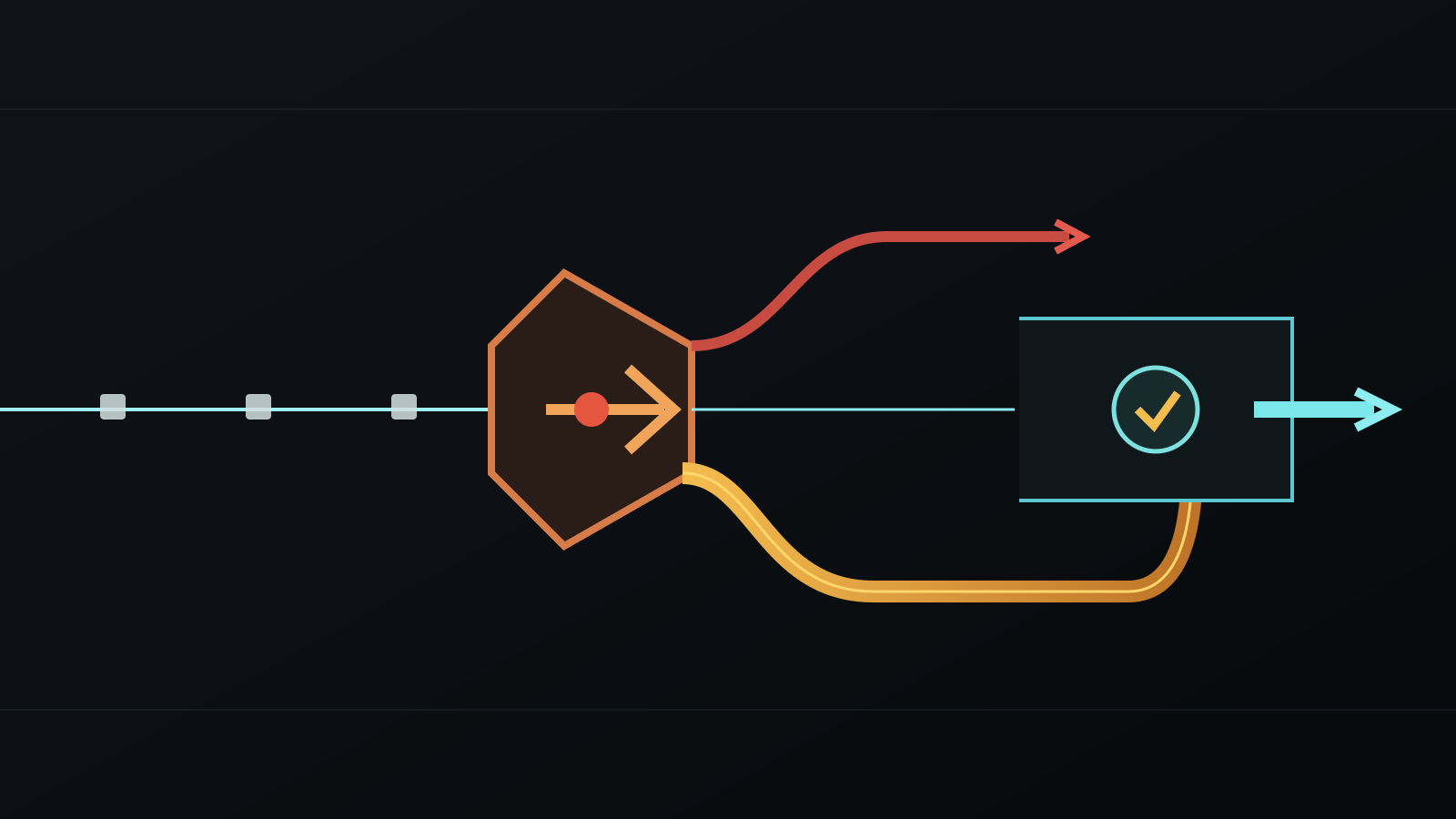
GRACEFUL DEGRADATION
RECORD → BOUND → DEFER → REVIEW
In this article
DIRECT ANSWERGraceful degradation keeps an automation useful when a dependency is slow, unavailable, rate-limited, or missing data. Define the minimum safe result first, isolate optional enrichment behind time and retry budgets, preserve a durable work record, and route unresolved work to a visible review queue. A fallback must reduce scope without hiding failure or repeating an irreversible action.
Key takeaways
- Define the minimum safe result. Decide what the workflow may still do when an optional dependency is unavailable.
- Make fallback explicit. A delayed, partial, or reviewable outcome is better than a silent success claim.
- Keep the business event durable. Store a stable event identity and state before attempting an external action.
- Use budgets. Timeouts, retry counts, queue limits, and provider limits are part of the design.
- Escalate with context. A reviewer needs the event, failure, safe completed work, and next action.
What is graceful degradation in an automation?
Graceful degradation means preserving the most important safe function when a non-essential dependency fails. A workflow can record a lead while enrichment is unavailable, save an uploaded document while extraction is delayed, or create a review task when a downstream API cannot confirm an action.
It does not mean swallowing errors, pretending a side effect completed, or silently changing a business decision. It means deciding in advance which outcome is truthful and safe at each failure boundary. The related public pattern is visible state, a clear failure path, and an owner for unresolved work; see retries and fallbacks, workflow observability, and human approval boundaries.
How do you design the fallback path?
Separate the operation into a required core and optional enrichments. For example, an inbound support request may need a durable ticket immediately, while classification, knowledge retrieval, and a draft reply can wait. If the model provider is unavailable, the system can still create the ticket, mark enrichment as pending, and route it to a human queue.
type Result =
  | { state: "completed"; ticketId: string }
  | { state: "degraded"; ticketId: string; pending: string[] }
  | { state: "review"; eventId: string; reason: string };

const ticket = await tickets.createIdempotently(event.id, event.payload);
try {
  const enrichment = await withTimeout(enrich(event.payload), 5000);
  await tickets.attachEnrichment(ticket.id, enrichment);
  return { state: "completed", ticketId: ticket.id };
} catch {
  await queue.enqueue({ eventId: event.id, ticketId: ticket.id, task: "enrich" });
  return { state: "degraded", ticketId: ticket.id, pending: ["enrichment"] };
}
The required ticket exists before optional enrichment begins. The example does not claim enrichment succeeded. If the core action is irreversible or uncertain, use reconciliation and an approval boundary rather than a fallback that could duplicate work.
Which budgets make degradation controlled?
Without limits, a fallback can become an overload path. Set a timeout for each dependency, a bounded retry policy for documented transient errors, a queue-size limit, a concurrency limit, and an owner for terminal work. AWS Well-Architected guidance recommends timeouts, retries with backoff and jitter, and load shedding to keep distributed systems from amplifying failure. AWS Reliability Pillar guidance
Provider documentation determines provider-specific behaviour. Google Cloud distinguishes retryable transient errors from requests that should not be retried without an idempotency strategy. Google Cloud retry strategy A rule that is safe for a read may be unsafe for a message send or payment.
When should fallback become human review?
Use human review when the workflow cannot verify the effect, data is incomplete or contradictory, an action has material external impact, or the fallback would change a decision rather than defer optional work. The review item should include the stable event ID, input reference, completed steps, failed dependency, retry history, and recommended next action.
A useful queue lets someone retry, correct an input, contact a user, or cancel work without rediscovering the whole event. It applies the same boundary in When Should AI Agents Require Human Approval?: the system may prepare a proposal, but a person authorizes consequential action.
What should you test before calling a fallback safe?
| Test case | Expected result |
|---|---|
| Optional provider times out | Core record persists, pending work is visible, and no false completion is reported. |
| Documented transient error | Only the bounded retry path runs, with the original event identity retained. |
| Required downstream action has an unknown result | Event moves to reconciliation or review; no blind replay occurs. |
| Queue reaches its limit | New optional work is delayed or refused explicitly; operators can see why. |
| Duplicate event delivery | Idempotency or a claim check prevents duplicate core work. |
| Human reviewer resolves a task | The final state, owner, and audit trail are recorded. |
Limitations
Graceful degradation is not a substitute for capacity planning, incident response, data protection, or a reliable primary dependency. A workflow that always falls back may hide a persistent fault. Monitor degraded and review states, investigate recurring causes, and decide when a service must pause rather than continue in reduced form.
This note draws on public reliability guidance and existing public writing on retries, idempotency, observability, and approval boundaries. It reports no client deployment, failure rate, recovery metric, service-level objective, or production result.
Executive summary
Graceful degradation preserves the smallest safe business result when a dependency fails, then makes deferred and unresolved work visible. Separate the core action from optional enrichment, persist state before side effects, bound retries and queues, reconcile unknown outcomes, and route consequential ambiguity to a person. A fallback is reliable only when it tells the truth about what did and did not happen.
Related services and reading
- n8n workflow development for validated integrations, explicit failure paths, and handoff-ready automation.
- How to add backpressure to n8n workflows and AI agents.
- How to prevent duplicate workflow executions with idempotency.
About the author
Harrison Ndeke is an AI automation developer in Nairobi who builds documented workflows, AI agents, chatbots, RAG systems, and API integrations. His public writing discusses validation, explicit error paths, duplicate controls, observable state, and human approval boundaries. This article applies those published boundaries to graceful degradation; it does not claim formal reliability certification or measured client outcomes.