FIELD NOTE 013 / PLATFORM CHOICE
n8n vs Make: Choosing an Automation Platform
An evidence-based comparison of n8n and Make covering self-hosting economics, code-node flexibility, node ecosystem, and when each platform is the better production choice.
By Harrison Ndeke · Published September 20, 2026 · Updated September 20, 2026 · 10 min read
PLATFORM CHOICE
SKILL → HOSTING → LOGIC COMPLEXITY
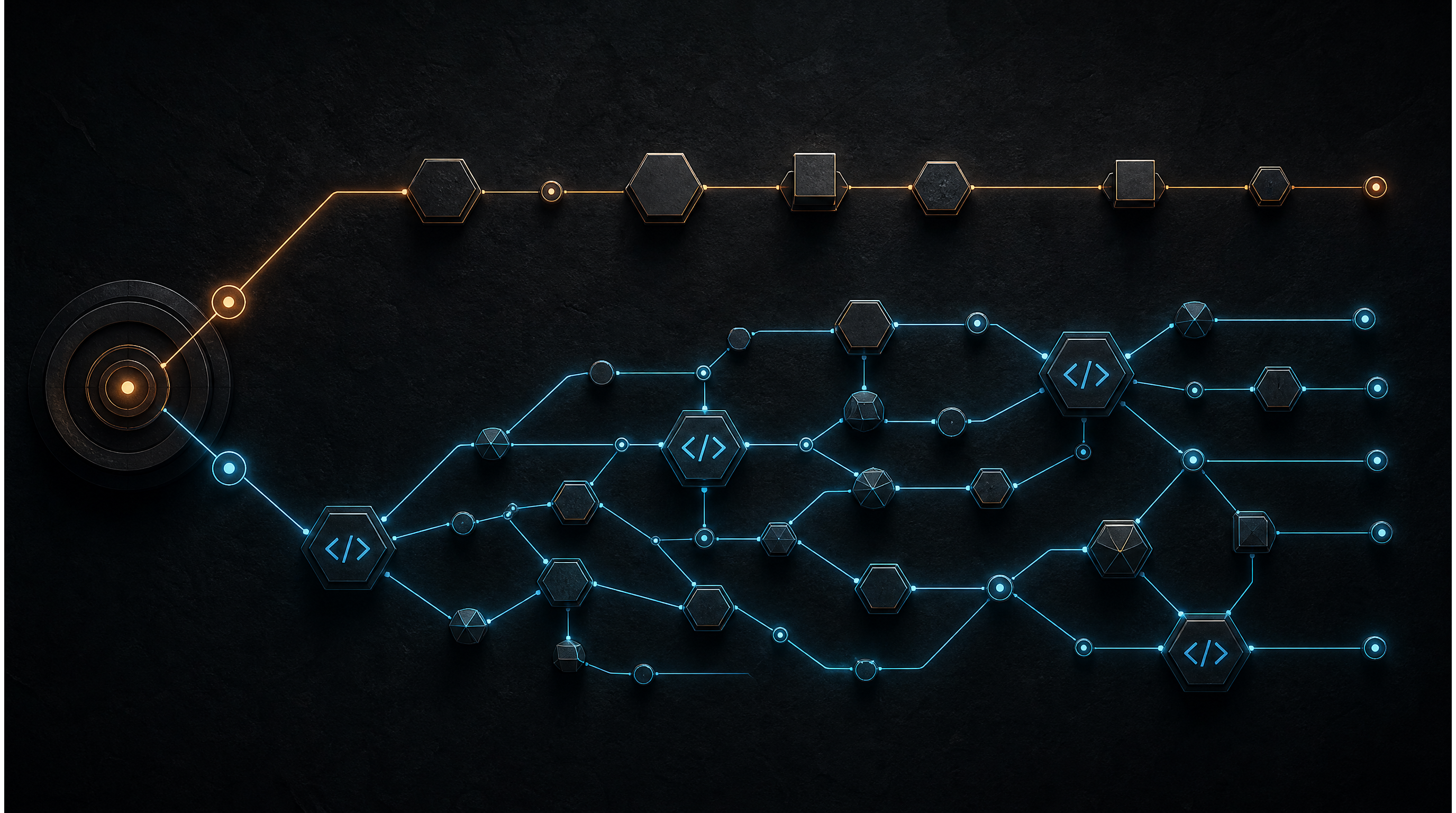
DIRECT ANSWERn8n and Make both connect APIs and automate multi-step processes, but they optimize for different things. Make optimizes for a fast, mostly-visual build with less code required; n8n optimizes for control — self-hosting, JavaScript/Python code nodes, and predictable cost at scale. A short workflow with standard integrations and no unusual logic is often faster to ship in Make. A workflow that carries AI agents, custom validation, or needs to run on infrastructure you control is usually a better fit for n8n.
Key takeaways
- Hosting model differs fundamentally: Make is cloud-only; n8n can be self-hosted or cloud, which changes the cost and data-residency conversation.
- Code flexibility differs: n8n's Code node runs real JavaScript or Python inline; Make's logic is built from its visual modules and a more limited function library.
- Pricing scales differently: Make bills by "operations" (each module execution); n8n's self-hosted tier bills by workflow executions, which can be materially cheaper at high volume.
- Neither is categorically better: the right choice depends on team skill, hosting constraints, and how much custom logic the workflow needs.
- Migration cost is real: moving a mature workflow between platforms means rebuilding logic, not just re-pointing credentials.
Hosting and cost: who owns the infrastructure?
Make is a managed SaaS platform only — there is no self-hosted option. That means zero infrastructure to operate, but also means every execution runs on Make's cloud, billed per operation, and data passes through Make's servers by default.
n8n ships as both a managed cloud product and an open-source, self-hostable application. Self-hosting shifts responsibility: you operate the database, manage updates, and handle uptime, but you also control where data lives and can run workflows without a per-operation cloud bill. For a team already running infrastructure, self-hosted n8n can be materially cheaper at volume. For a team with no infrastructure operations capacity, that responsibility is a real cost, not a saving.
How much custom logic can each platform actually run?
Make's automation logic is assembled from prebuilt modules, routers, filters, and a limited set of built-in functions. Complex conditional logic is possible but gets visually dense fast, and there is no general-purpose scripting environment inside a Make scenario.
n8n includes a Code node that runs arbitrary JavaScript (and, via a separate node, Python) directly inside the workflow — full control over data transformation, custom API signing, recursive logic, or calling an npm package. This matters specifically for AI agent workflows: validating a model's structured output against a JSON schema, computing an idempotency key, or handling a multi-step retrieval pipeline is straightforward in a Code node and awkward to express in a purely visual builder.
// n8n Code node — not expressible as a single Make module
const key = crypto.createHash("sha256")
  .update(`${tenantId}:${operation}:${sourceId}`)
  .digest("hex");
return [{ json: { idempotencyKey: key } }];
Node and integration ecosystem
| Dimension | n8n | Make |
|---|---|---|
| Built-in integrations | Hundreds of app nodes plus generic HTTP Request node for anything else | Thousands of app modules, generally broader third-party coverage out of the box |
| Community extensions | Open-source community nodes, installable on self-hosted instances | No equivalent community-node ecosystem; limited to Make's own module catalog and custom apps |
| Custom API calls | HTTP Request node handles any REST/GraphQL API without a dedicated integration | HTTP module exists but is less commonly reached for since the module catalog covers more cases |
| AI/LLM nodes | Native LangChain-based AI Agent, vector store, and memory nodes | AI app modules exist (OpenAI, Anthropic, etc.) but agentic/tool-calling patterns are less native |
If the integration you need already exists as a well-maintained Make module, that module is often faster to configure than the equivalent n8n HTTP Request setup. If the integration is obscure, internal, or requires custom auth handling, n8n's Code node and HTTP Request node give more direct control.
When is Make the better call?
Make tends to win for a small team without engineering capacity that needs a working integration quickly, uses well-supported SaaS tools end to end, and does not need self-hosting for compliance or cost reasons. A marketing team connecting a form tool to a CRM and a Slack notification is a reasonable Make use case.
When does n8n's control matter more?
n8n tends to win once a workflow needs custom validation logic, connects to internal or unusual APIs, must run on infrastructure the business controls for compliance or cost reasons, or coordinates AI agents with tool calls, retrieval, and structured-output validation. Production automation carrying financial transactions, PII, or AI-agent decisions benefits from the auditability of code you can read line by line, and from hosting you control.
Executive summary
The comparison is not "which platform is more powerful" — it is "which platform matches this team's skill level, hosting constraints, and the complexity of this specific workflow." Make reduces time-to-first-working-automation for standard integrations. n8n trades some of that initial speed for code-level control, self-hosting, and a cost model that scales better with execution volume. Teams building AI agent systems, or anything with real failure consequences, generally end up on n8n specifically because the logic outgrows what a visual-only builder can express cleanly.
Related services and reading
- n8n Automation Services for production workflow development with validation, retries, and handoff.
- RAG Explained for the retrieval architecture pattern that benefits most from n8n's Code node flexibility.
- Backpressure in n8n workflows for controlling load on AI agent nodes under volume.
About the author
Harrison Ndeke is an AI automation developer in Nairobi building production n8n workflows, agents, and API integrations. This comparison reflects platform capabilities as publicly documented and is not sponsored by either vendor.
Sources, scope, and limitations
Primary sources: n8n documentation and Make Help Center. Pricing and feature sets change over time — verify current tiers and limits directly with each vendor before making a platform decision.