FIELD NOTE 011 / RAG PROVENANCE & RBAC
How to Maintain RAG Source Freshness, Evidence Provenance, and Access Control
A practical architecture for automated knowledge base synchronization, RBAC vector filtering, citation schemas, and retrieval evaluation in enterprise workflows.
By Harrison Ndeke · Published September 13, 2026 · Updated September 13, 2026 · 14 min read
ENTERPRISE RETRIEVAL INTEGRITY
BOUND → FILTER → PROVE → EVALUATE
In this article
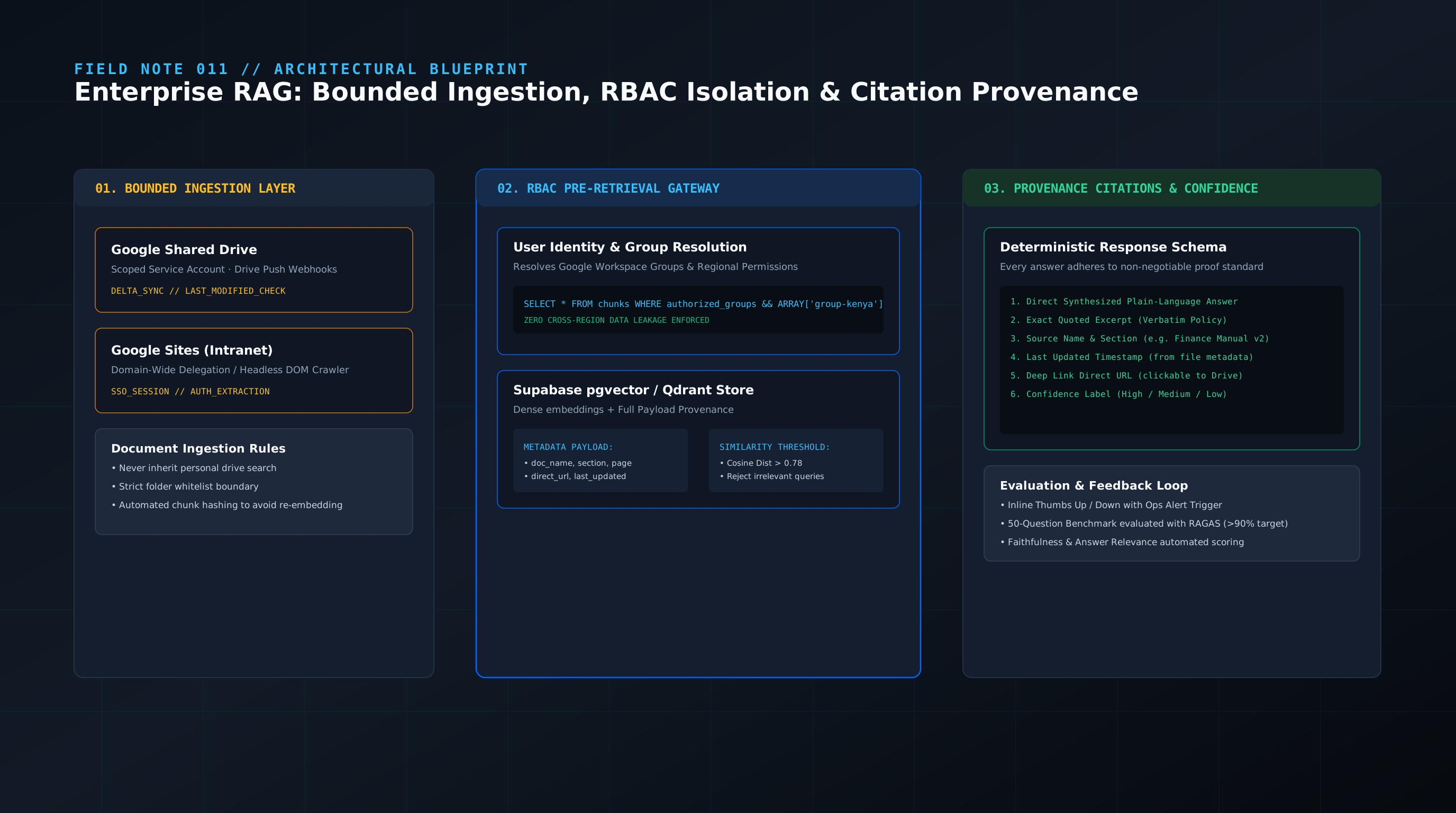
DIRECT ANSWERMaintain enterprise RAG reliability by bounding document ingestion strictly to approved organizational drives, applying pre-retrieval Role-Based Access Control (RBAC) filtering on vector metadata to guarantee zero cross-region data leakage, attaching verbatim quotes with deep links and last-updated timestamps to every response, and evaluating accuracy against a 50-question benchmark before rollout.
Key takeaways
- Bound the corpus explicitly: Never inherit unrestricted user drive access or broad enterprise search; ingest only whitelisted folders and approved intranet pages.
- Enforce access control before vector search: Tag every embedded chunk with group permissions and filter at the database layer (
WHERE authorized_groups && ARRAY[user_groups]) so unauthorized context is never retrieved. - Automate source freshness: Sync delta changes via drive push notifications or content hashes so Global Operations updates policies in one single location.
- Enforce a strict citation schema: Every response must return a synthesized answer, verbatim quote, document section, last-modified timestamp, deep link URL, and confidence label.
- Benchmark against real questions: Evaluate retrieval precision, faithfulness, and answer relevance across a 50-question test set targeting 90%+ accuracy prior to organization-wide launch.
Why naive RAG fails in distributed organizations
When an organization operating across multiple countries or departments deploys a generic RAG chatbot, two catastrophic failure modes emerge:
- Cross-Region Data Leakage: A staff member in Uganda asks about local per-diem or procurement rates and receives policy text meant exclusively for Kenya or Nigeria because the vector search performed a purely semantic lookup without permission constraints.
- Stale Knowledge & Phantom Hallucinations: The assistant answers with outdated 2024 compliance rules because policy documents were manually copied into the vector store at launch and never re-indexed when operations updated the official Drive.
Harrison’s public mission archive documents production retrieval systems in Standout4Growth RAG Chatbot, combining vector storage in Supabase with scoped conversation memory. Enterprise deployments require moving beyond single-tenant retrieval to strict permission boundaries and automated delta synchronization.
How to bound the knowledge base
Enterprise knowledge must be bounded to explicitly approved sources. An internal assistant should never search an employee’s personal Google Drive, unvetted Slack channels, or public web results unless specifically authorized.
| Source Type | Ingestion Mechanism | Freshness Trigger | Boundary Guard |
|---|---|---|---|
| Google Shared Drive | Service Account with Domain-Wide Delegation | Google Drive Push Webhooks / Scheduled Delta Poll | Whitelisted Root Folder IDs only |
| Intranet (Google Sites) | SSO-authenticated DOM parser / Drive backend sync | Weekly re-crawl / Content Hash Comparison | Approved sub-paths only; exclude draft pages |
| Operational Manuals (PDF/Docs) | Structure-aware chunking (Markdown / Heading splits) | Document update event | Strip comments, tracking tags, and hidden revisions |
Enforcing Role-Based Access Control (RBAC) at the retrieval layer
Filtering must happen before or during the vector similarity query, never as a post-generation prompt check. If an LLM reads unauthorized context in its prompt, prompt injection or summarization leaks can expose confidential text.
Every ingested chunk in PostgreSQL (pgvector) or Qdrant carries an ACL metadata payload mirroring organizational Google Groups or department IDs:
{
  "chunk_id": "chk_9821a",
  "document_id": "doc_procurement_ke_2026",
  "document_name": "Kenya Procurement Standard v4.pdf",
  "section": "Section 3.2: Field Advances",
  "authorized_groups": ["group-kenya-all@org.org", "group-global-ops@org.org"],
  "source_url": "https://drive.google.com/file/d/1A2B3C/view",
  "last_modified": "2026-08-15T09:30:00Z"
}
When an employee submits a query, the backend resolves their authenticated identity and active Google Groups, executing a hard SQL filter:
-- Supabase pgvector retrieval query with hard RBAC filter
SELECT
  id, content, metadata,
  1 - (embedding <=> query_embedding) AS similarity
FROM document_chunks
WHERE authorized_groups && ARRAY['group-kenya-all@org.org']::text[]
  AND 1 - (embedding <=> query_embedding) > 0.78
ORDER BY similarity DESC
LIMIT 5;
This guarantees mathematical zero cross-region visibility: an employee assigned to Uganda cannot retrieve Kenyan policy chunks, regardless of what query they type.
Maintaining source freshness without double maintenance
Non-technical operations teams should never have to update a policy in two separate systems (once for the intranet and once for the AI knowledge base).
- Single Source of Truth: Operations edits the live Google Doc in the Shared Drive.
- Automated Ingestion Webhook: Google Drive fires a change notification to an n8n workflow.
- Chunk Diff & Upsert: The workflow computes MD5/SHA256 hashes of document sections. Only modified sections are re-embedded and upserted into the vector database.
- Tombstoning: Deleted or archived files are instantly purged from the index using their
document_id.
Enforcing a deterministic provenance schema
Every response given by the AI assistant must follow an explicit, non-negotiable contract rather than being left to the model's creative style:
| Output Field | Requirement | Purpose |
|---|---|---|
| Direct Answer | Synthesized plain-language answer in 2–3 sentences. | Immediate clarity for the user. |
| Quoted Excerpt | Verbatim excerpt from the source document, in quotation marks. | Auditability and verifiable evidence. |
| Source & Section | Exact document title and section heading (e.g., Travel Policy 2026 — Section 4.1). | Contextual attribution. |
| Last Updated | ISO date extracted from file metadata. | Proves policy currency. |
| Direct URL | Working HTTPS link to the exact Google Drive or Intranet document. | One-click verification by staff. |
| Confidence Label | High, Medium, or Low. | Signals source ambiguity or conflicting documents. |
How confidence scoring and feedback loops operate
Confidence should not be a black-box guess. In our RAG architectures, confidence is computed as a hybrid metric:
- Semantic Distance: Average cosine similarity of top retrieved chunks (> 0.82 = High, 0.75–0.82 = Medium, < 0.75 = Low).
- Source Conflict Check: If two retrieved chunks with equal similarity make contradictory claims (e.g., conflicting per-diem numbers), the model is instructed to flag
Medium/Lowconfidence and display both excerpts. - Staff Feedback Loop: Every answer features an inline thumbs-up / thumbs-down button. Any negative feedback or Low confidence response logs an alert for Global Operations to clarify the underlying policy.
Benchmarking retrieval accuracy before deployment
Never release an enterprise RAG assistant without measuring performance against an agreed test set. We construct a 50-Question Real-World Benchmark with the client operations team covering:
- Standard single-hop policy queries (30 questions).
- Multi-document synthesis across finance and HR (10 questions).
- Out-of-scope and cross-region permission test cases (10 negative tests to confirm refusal).
Using evaluation frameworks like RAGAS, the system is measured on Faithfulness (answers grounded in retrieved context), Answer Relevance (directly addressing the user prompt), and Context Precision (retrieving the exact section needed). Only when the pipeline exceeds a verified 90%+ pass rate is organization-wide deployment approved.
The smallest useful implementation roadmap
- Inventory Whitelisted Sources: Identify specific Shared Drive folder IDs and intranet URLs; prohibit personal drive scope.
- Define the Group Access Matrix: Map Google Workspace Groups to regional and departmental tags.
- Build Ingestion in n8n: Create the document chunker, hash generator, embedding step, and vector upsert pipeline with metadata tagging.
- Implement Pre-Retrieval RBAC: Enforce metadata array filtering on every query.
- Lock Response Formatting: Use structured output JSON schemas enforcing quotes, source URLs, timestamps, and confidence tags.
- Run the 50-Question Benchmark: Verify precision and access control before organizational launch.
Executive summary
Enterprise RAG assistants succeed when they respect organizational boundaries. Treating knowledge as bounded, enforcing RBAC access control before retrieval, automating sync directly from Google Drive, and enforcing structured citations with confidence scoring creates an internal assistant staff and leadership can depend on.
Related services and field notes
- n8n automation services in Kenya for production workflow engineering.
- Chatbots and RAG systems for bounded vector retrieval architecture.
- Defending RAG agents against prompt injection for untrusted content boundaries.
- Validating AI tool calls with JSON Schema for typed output contracts.
- Observing automation workflows for telemetry and error tracking.
About the author
Harrison Ndeke is an AI automation developer and systems architect based in Nairobi, Kenya. He specializes in production n8n workflows, Next.js web applications, vector retrieval pipelines, and enterprise AI automations.