FIELD NOTE 027 / PRODUCTION RISK
What AI Automation Breaks in Production (and How to Prevent It)
The failure modes that kill automation projects after launch — silent errors, runaway agents, data drift — and the guardrails that stop them.
By Harrison Ndeke · Published October 17, 2026 · Updated October 17, 2026 · 9 min read
PRODUCTION RISK
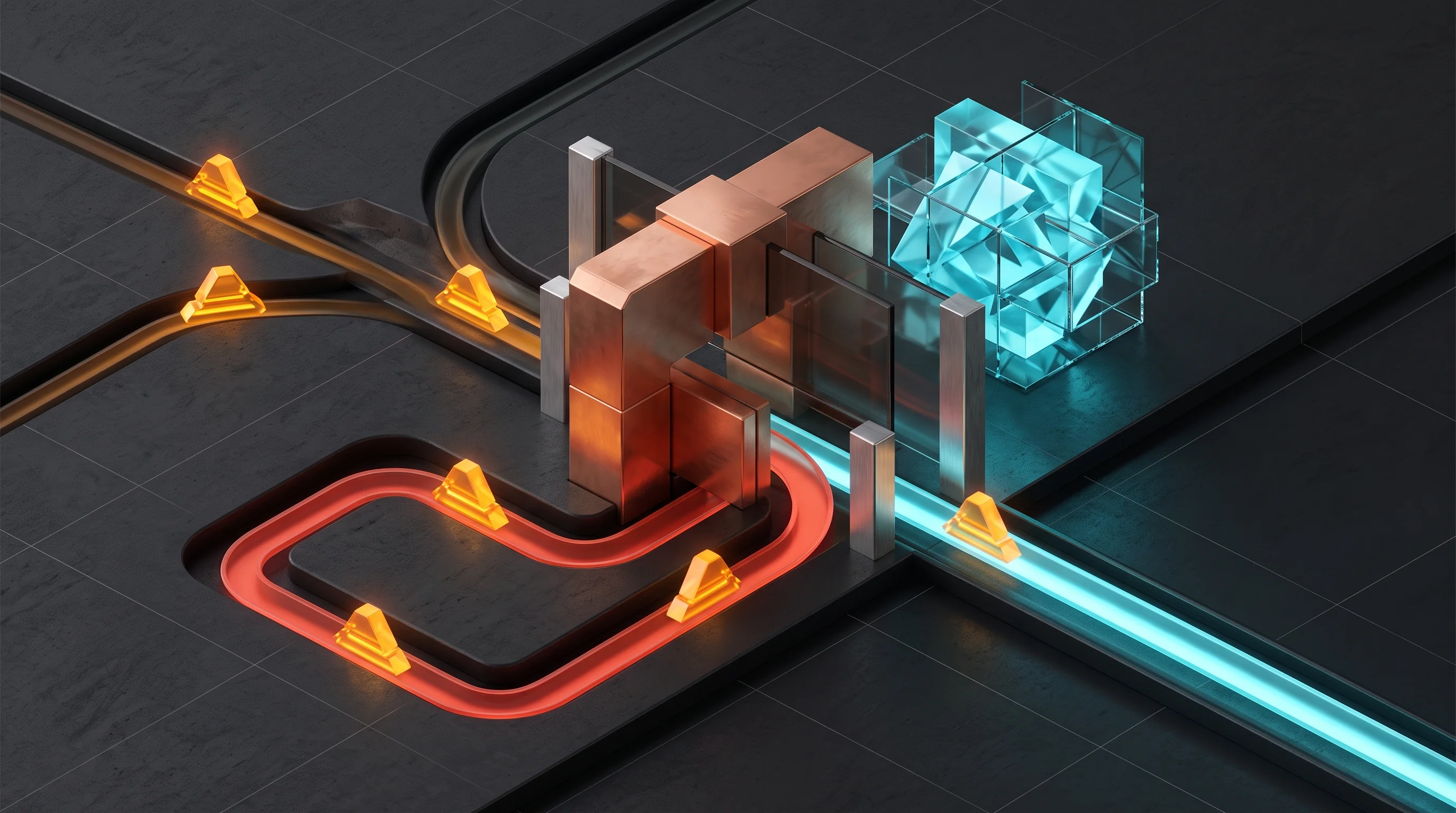
DETECT → DEDUPLICATE → AUTHORIZE → ROLL BACK
In this article
DIRECT ANSWERMost AI automation doesn't fail at the demo — it fails at 2am: silent errors, duplicate executions, agents acting beyond their permissions, stale data feeding decisions, and no rollback. The five failure patterns below repeat across builds that launched fine and quietly corroded. Each one maps to a specific guardrail that must be in the design before launch, not after the first incident.
Key Takeaways
- Failure states are designed, not hoped away: Every workflow either has a designed answer for each of the five patterns — or an accidental one that surfaces as an incident.
- Silence is the expensive failure: An error with no alert becomes a customer-visible failure hours later. Detection has to be part of the build, not an afterthought.
- Idempotency prevents "it happened twice," with a stable business key, a check-before-acting step, and a durable record of what already happened. Our dedicated field note covers preventing duplicate workflow executions with idempotency.
- Permissions bound agents:An automation acts with scoped authority for the single action it needs — not the owner's account, and never unconstrained discretion over money or data.
The 5 Failure Patterns That Kill Automation After Launch
1. Silent errors with no alerting
The flow works — until a provider rate-limit is swallowed, a record silently fails to sync, or the model returns text that parses as nothing. Nothing crashes. Nothing alerts. The first signal is a customer asking why their issue was never handled, three days late. If a failure can happen and stay invisible from the launch document, it will happen and stay invisible.
2. Duplicate executions and double actions
A webhook that fires twice, a retry that succeeds after the first attempt already committed, a cron that overlaps its own run — the workflow with no idempotency layer sends the customer two messages, charges twice, or writes a duplicated record. This is the classic that "never happens in the demo because you never clicked twice."
3. Agents exceeding their permissions
A model-driven agent with the account owner's credentials and an instruction that drifts slightly off-script — quietly touching records it was never meant to see or mutate, or taking a financially consequential action nobody asked for. The fix is a permission boundary set before launch: the agent's tool list, the fields it can touch, the actions that always stop for human approval. Our field note on AI agent human approval boundaries covers exactly where that approval gate must sit.
4. Stale and ungoverned data feeding decisions
The system still runs, but the data it leans on has quietly drifted: a source database no longer updated, a report nobody re-exported, a lookup table with yesterday's prices. The automation executes perfectly against a wrong world. Unless data freshness is measured and stale sources are flagged, the workflow is a machine for making confident mistakes.
5. No rollback plan
The bad run already happened: three hundred customers messaged, a batch written to the wrong ledger, a campaign fired. Without a rollback plan — captured pre-images, reversible writes, a one-command halt — the recovery is manual archaeology. Some twelve-hour incidents are just a rollback plan that was never written down.
The Guardrails That Map to Each Pattern
- Monitoring and alerting → failure 1: every step pair logs its own pass/fail, failures escalate to a channel a human actually reads, and the alert names the stage and execution reference so questions start with evidence, not memory.
- Idempotency and deduplication → failure 2: stable keys per business event, check-before-act statements, durable record of completed effects — layers documented in field-note depth on idempotency; the dead-letter-queue and bounded-retry pattern also appears in the architecture of the CRM automation platform mission, which pairs lead intake with automatic retry of failed CRM sync attempts.
- Bounded permissions and HITL checkpoints → failure 3: scoped credentials, schema-validated tool calls, human approval before irreversible or sensitive actions. For classification and extraction work, our Gmail analysis mission shows the pattern live: classification, dedup, and human sign-off via messaging on the high-stakes replies only.
- Data governance → failure 4: measured freshness per source, ownership per dataset per field, staleness thresholds that pause automated decisions instead of a silent cadence of confident output.
- A designed rollback path → failure 5: reversible or journaled writes, a halt switch, and a rehearsed recovery — written in your handover documentation rather than retrofitted on an incident night.
Where This Shows Up in the 48-Hour Assessment
These patterns aren't theoretical — the 48-hour workflow assessment is deliberately structured to surface them before a build is quoted. Inside the 48 hours, the evidence review checks where an automation partner would catch a silent failure: monitoring, authority, dedup, staleness, rollback. If your current systems or a proposed build is missing a guard, the review itemizes exactly where, and the quoted scope includes fixing those before launch — not patching them at the first incident. The same review logic underpinned our guide to choosing an AI automation consultant in Kenya: ask what a provider does to guarantee safety after the demo, not just whether it can demo.
Frequently Asked Questions
What's the first failure mode worth defending against in most builds?
Silent errors without alerting. Duplicates, drift, and permission mischief all show up when someone checks; silence is the only failure that never gets a chance to be caught because nobody — including you — knew it was happening. Put monitoring and failed-run notifications before almost any other guardrail in a new build.
How do I know if my pipeline is vulnerable to duplicate executions?
Ask the two questions that matter: does a repeated event share a stable key the workflow can recognize, and does any step write a record of the effect before or as the write happens? If the workflow relies purely on "the webhook fires once" and writes with no record, it's vulnerable in production yet invisible in testing — the classic pattern the idempotency field note closes off.
What should happen when a human-approval step exists in a workflow?
Park the pending action with enough context — who the customer is, what the action is, what evidence led there — so the person reviewing is deciding, not reconstructing. The approving step records its own answer. Without those pieces, "human in the loop" paper-trails into an unclaimed inbox milestone.
Is rollback ever really possible with AI automation, or is it theory for most businesses?
It's feasible without custom software for most SME-scale builds by design, not by tooling: reversible writes, journaled records, limiting blast radius, and manual replay procedures. Deep transactions — banks, stocks, side-calls — are where rollback gets genuinely hard, and those are exactly the actions where a human approval checkpoint costs far less than reverse-engineering a money transfer after a bug.
Design for the 2am Failure
If you already run automation that could fail any of these five ways tonight, the 48-Hour Secure Digital Workflow Assessment (KSh 35,000 / $280) reviews it against this same checklist, with fixes quoted in the fixed-price proposal. If you're about to build — run the guardrails as design inputs from the start.
- Email: ndekeharrison8@gmail.com
- Phone: +254 792 185 625
- WhatsApp: Chat on WhatsApp (+254 792 185 625)